Permafrost Carbon Supersite Description
2026-04-28
Eight Mile Lake Sites
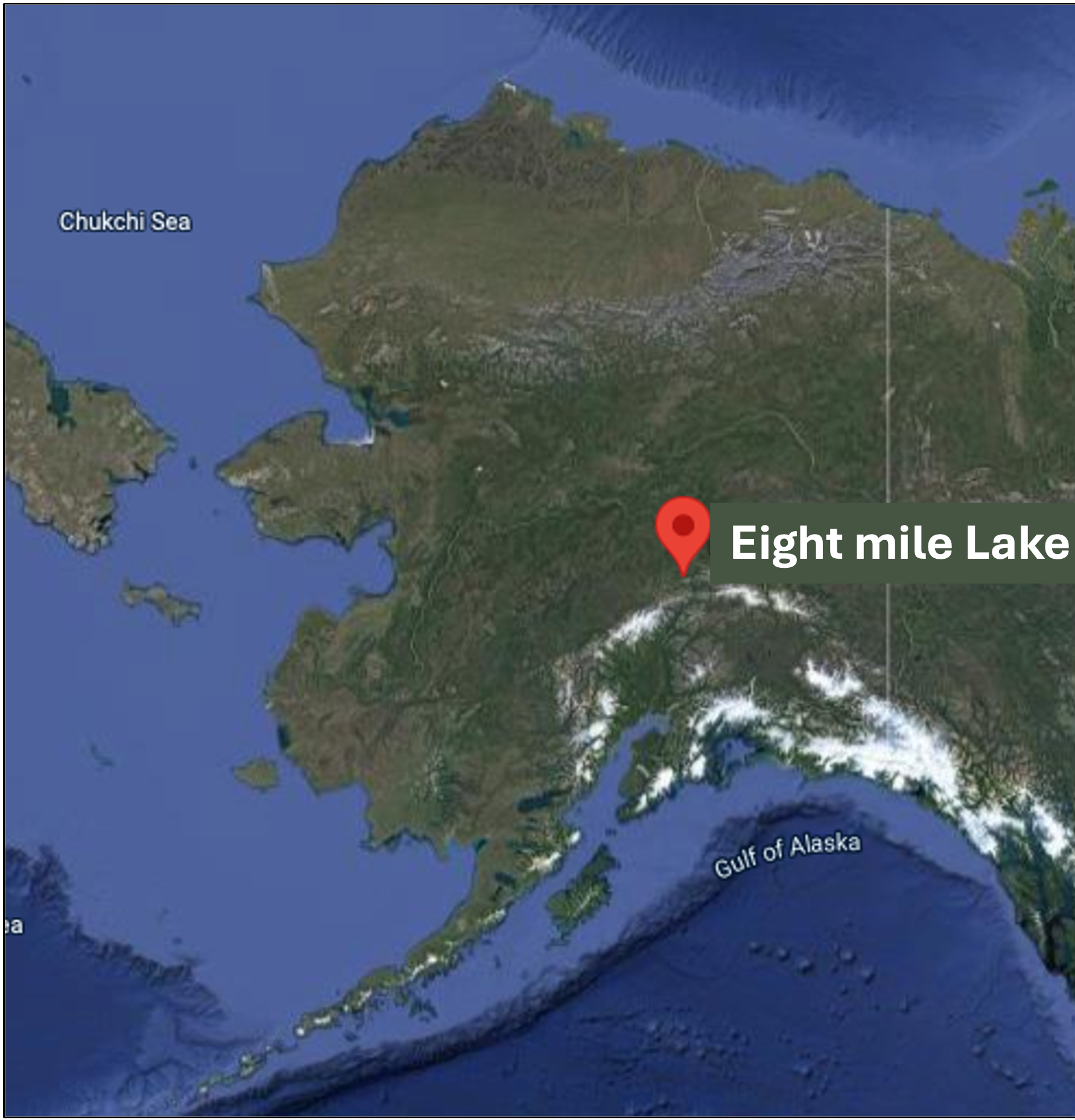
Location of the ACCLIMATE study site within the interior of Alaska just outside Denali National Park.
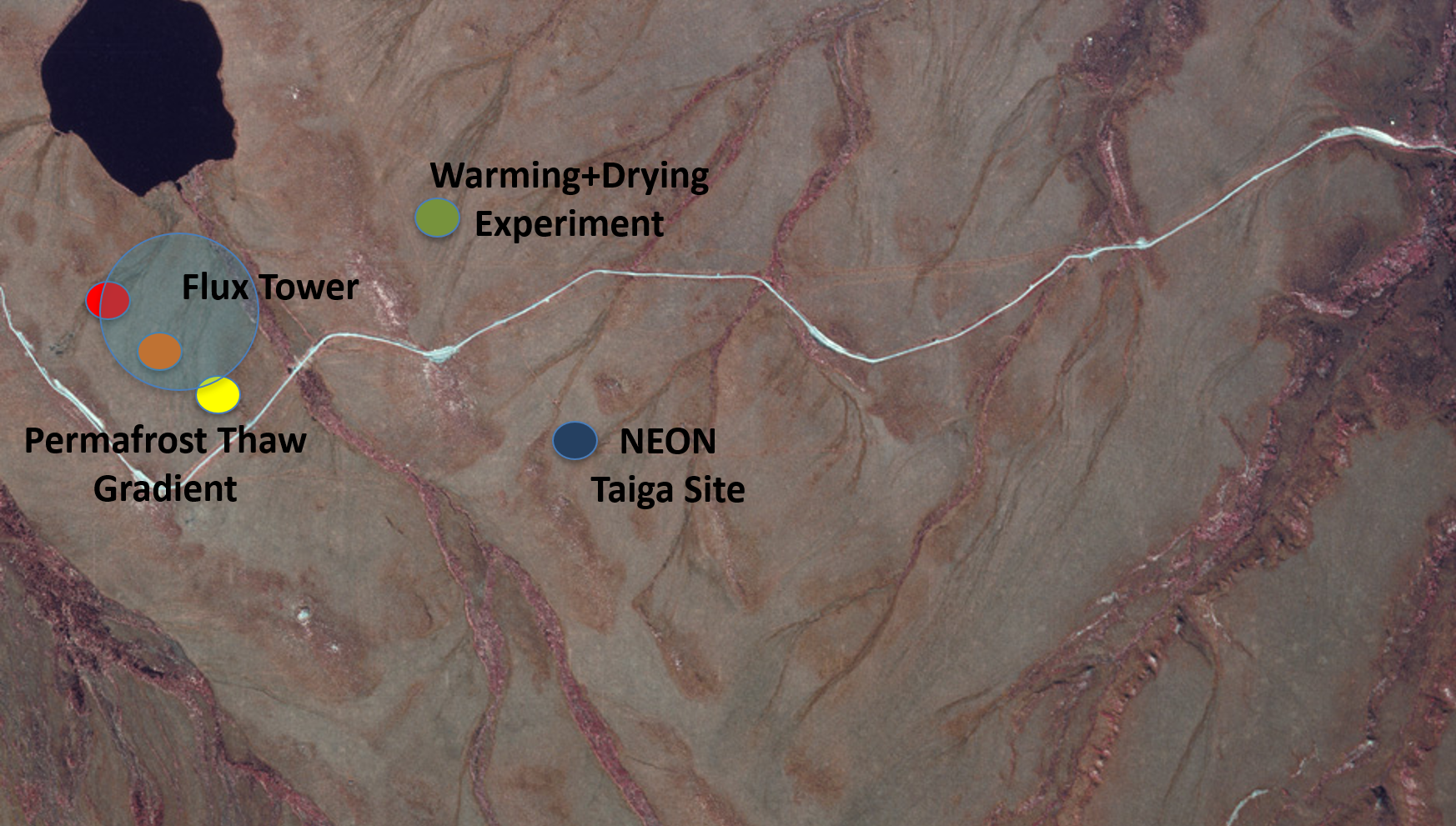
Aerial view of the study location accessed by the Stampede Road as the white line across the image. Eight Mile Lake in the top-left corner of the image with the Permafrost Thaw Gradient below monitored by an eddy covariance tower. Within the Gradient, the Extensive (red), Moderate (orange), and Minimal (yellow) thaw sites represent locations that differed in thaw depth at the outset of the study. The warming and drying experimental site (green) manipulated soil temperature, permafrost, and water table. The National Ecological Observation Network (NEON) Taiga site (blue) is located in the vicinity.
Arctic Carbon and Climate (ACCLIMATE) Observatory
Located in the northern foothills of the Alaska Range, the Arctic Carbon and Climate Observatory (ACCLIMATE) comprises two main sites - the Permafrost Thaw Gradient and the warming and drying manipulation (CiPEHR. Vegetation is moist acidic tundra dominated by tussock sedges, deciduous and evergreen shrubs with an understory of mosses. The site has a 25 cm organic layer overlying mineral soil mixed by freeze-thaw, with significant carbon storage. The underlying permafrost is thawing due to its relatively warm temperature and regional climate change.
- Soils are Gelisols with an organic layer above cryoturbated mineral soil.
- Active layer depth is approximately 50-80 cm and is increasing with thaw.
- Mean annual temperature is around -1.0°C.
- Significant carbon storage, 50-60 kg C per cubic meter.
- Permafrost temperatures to 30 m depth are just above -1°C.
- Vegetation is dominated by the sedge Eriophorum vaginatum with deciduous shrubs such asVaccinium uliginosum.
The Permafrost Thaw Gradient
The Permafrost Thaw Gradient features three distinct areas representing varying degrees of permafrost thaw: Minimal, Moderate, and Extensive. The Extensive thaw area has experienced decades of thaw since before 1950, resulting in significant vegetation changes and ground surface subsidence. Research here focuses on understanding the feedbacks between permafrost thaw and climate change, with ongoing monitoring of soil conditions and carbon fluxes. The site includes a long-term permafrost borehole established in 1985 and an eddy covariance tower established in 2008.
- Focuses on investigating feedbacks between permafrost warming and climate change.
- Features a natural gradient of degrading permafrost.
- Extensive thaw shows significant vegetation change and ground surface subsidence due to loss of ground ice.
- 30m deep permafrost borehole temperature monitoring since 1985.
- Ongoing monitoring of environmental variables: soil temperature, thaw depth, water table, and decomposition since 2004.
- Eddy covariance flux tower has measured CO2 flux and radiocarbon measurements from 2004-present with CH4 added in 2016.
- Extensive radiocarbon measurements of carbon pools and fluxes tracks the loss of old carbon as a result of permafrost thaw.
Warming and Drying Experiment
The Carbon in Permafrost Experimental Heating Research (CiPEHR) project was a controlled warming experiment designed to study the effects of increased soil temperatures on permafrost thaw and the impacts to carbon cycling. It used snow fences in the winter combined with snow shoveling to induce deep soil warming and permafrost thaw and open-top chambers to induce air warming. Core measurements include soil conditions, thaw depth, carbon dioxide and methane fluxes, and plant productivity. The experiment aims to provide insights into future carbon cycle changes due to climate warming. There was a water table manipulation nested within the warming experiment. All active manipulations concluded by 2022 and the individual plots are currently monitored for changes in permafrost and carbon following this experiment.
- Ecosystem warming experiment established in 2008; Nested drying experiment in 2011.
- Designed to test hypotheses about carbon cycle changes due to warming.
- Snow fences+shoveling used for soil warming; open-top chambers for air warming, alone and in combination, with nearby unmanipulated control plots.
- Measurements include plant productivity, nutrient status, methane fluxes, carbon dioxide fluxes, radiocarbon and ancillary environmental variables.